

Image credit: Haley Nelson
In the 2025-26 academic year, the Center for Teaching and Learning (CTL) launched a set of teaching mini-grant opportunities for full-time faculty to propose projects for up to $2,500 in funding to support faculty excellence and student success. Teaching mini-grants challenge instructors to think creatively about their teaching and make bold curricular choices that work towards every student graduating with meaningful learning experiences. When faculty submit proposals, their mini-grant teaching project must connect to OSU’s Quality Teaching Framework or OSU’s strategic plan, Prosperity Widely Shared. In its inaugural year, the CTL received 43 proposals and was able to fund 18 teaching projects. In this article, we highlight three funded projects that demonstrate the impact of these mini-grants on student learning.
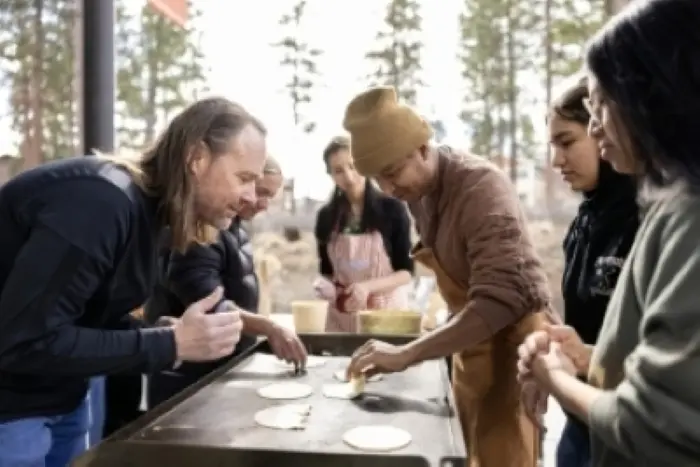
Jennifer Reimer’s (College of Liberal Arts, OSU-Cascades) mini-grant project, “Embodied Perspectives: Integrating Scholar and Community Voices in Ethnic Studies,” funded a speaker series across two of her Ethnic Studies courses (ES 201 and ES 211) at OSU-Cascades. As Reimer wrote in a blog post describing the project: “The series aimed to elevate community-based knowledge alongside academic scholarship.” Reimer reported that one of the most memorable sessions featured a hands-on workshop where students “explored the cultural and Indigenous significance of masa through the process of making tortillas” with a local chef (see image above). Experiential learning that centers the lived experiences of community members can be a powerful pedagogical approach. One of Reimer’s students described how the experience made learning about ethnic studies real, contemporary, and connected to their local community: “We weren’t just talking about a culture and its histories [...] but actively engaging with it. […] Our cultures aren’t just a far-removed abstract idea, but neighbors who can positively contribute to the community.” Reimer noted that “integrating scholar and community voices requires planning, resources, and institutional support,” and “the CTL mini-grant made this work possible.”
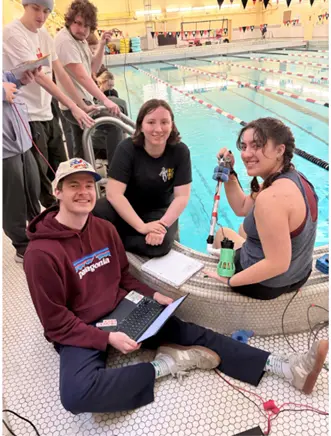
Image Credit: Kim Kenny
Hands-on learning experiences were also at the center of the mini-grant project “’Getting Our Hands Wet’: Engaging Students with Experiential Opportunities in the Ocean Sciences Technology Sector,” by Kelsey Lane (College of Earth, Ocean, and Atmospheric Sciences). Lane described how students in her classes have limited opportunities for hands-on experience with sensors and platforms. Lane used the teaching mini-grant funding to purchase SeaMate vertical profiler kits, which allowed each team to work with construction, wiring, and troubleshooting. Part of the course experience included a “dunktest” at Langton Hall pool, where students were able to collect temperature data and troubleshoot build issues (see image to the left). One of Lane’s students noted that they “really liked getting to troubleshoot the sensors [...] building and testing the profiler was a great way to see how the skills you’re teaching may be used in the workplace.” Lane’s mini-grant project worked toward achieving goals in Prosperity Widely Shared through expanded technical course offerings and career pathways for a new Ocean Technology Certificate.
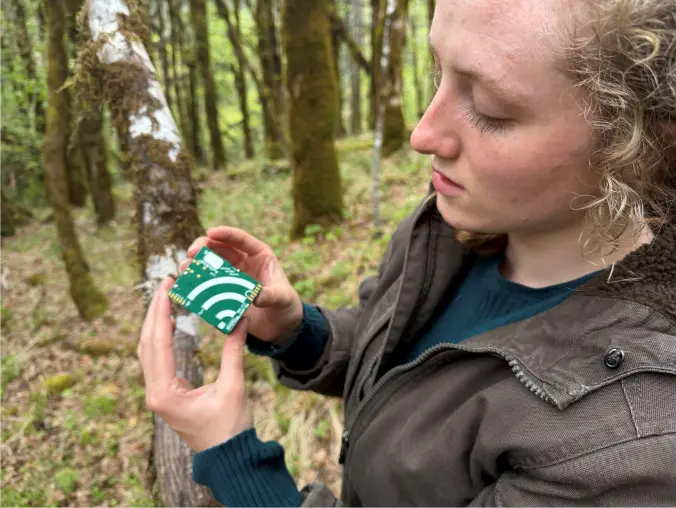
Image Credit: Mena Moran
A final example of a funded teaching mini-grant project involved the purchase of AudioMoth passive acoustic recorders to enable students to collect real-world bioacoustic data and analyze bird communities (see image to the right). Douglas Reese, (College of Agricultural Sciences (CAS)) submitted the mini-grant proposal for the recording equipment that was used for field-based STEM experiences in multiple courses. As Reese and colleagues Cherish Lyda (CAS), Mena M. Moran (CAS), and Joshua Reese (College of Science) explain: “students use AI-assisted species identification tools (BirdNET) to translate raw audio into ecological insight, bridging fieldwork, technology, and data analysis.” This project advances OSU’s priorities by promoting active and applied learning, providing equitable access to experiential learning, and enabling sustained faculty-student mentoring through the research process.
The call for 2026-27 teaching mini-grant proposals is currently open, with proposals due by May 18, 2026. We look forward to continuing to support innovative teaching to enhance student learning and engagement at OSU.
Written by Ashley Holmes, Associate Vice Provost for Faculty Excellence and Executive Director of the Center for Teaching & Learning, Division of Academic Affairs